It records both sides of the call, writes the transcript and the summary with the models already inside macOS, and pulls out what people actually agreed to. There is no server, so there is nothing to trust us about. Pull the network cable mid meeting and it keeps working.
No card for the trial · nothing uploaded, ever · macOS 26 on Apple Silicon · signed and notarized
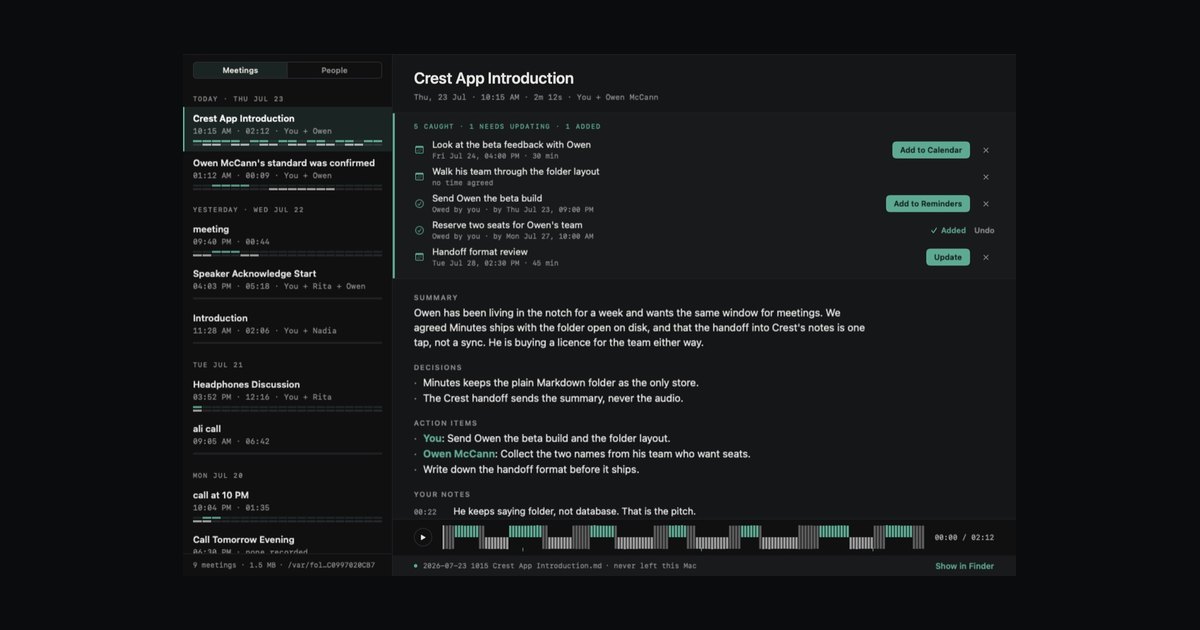
68 seconds: the meeting, written down on this Mac. Drawn from the real interface.
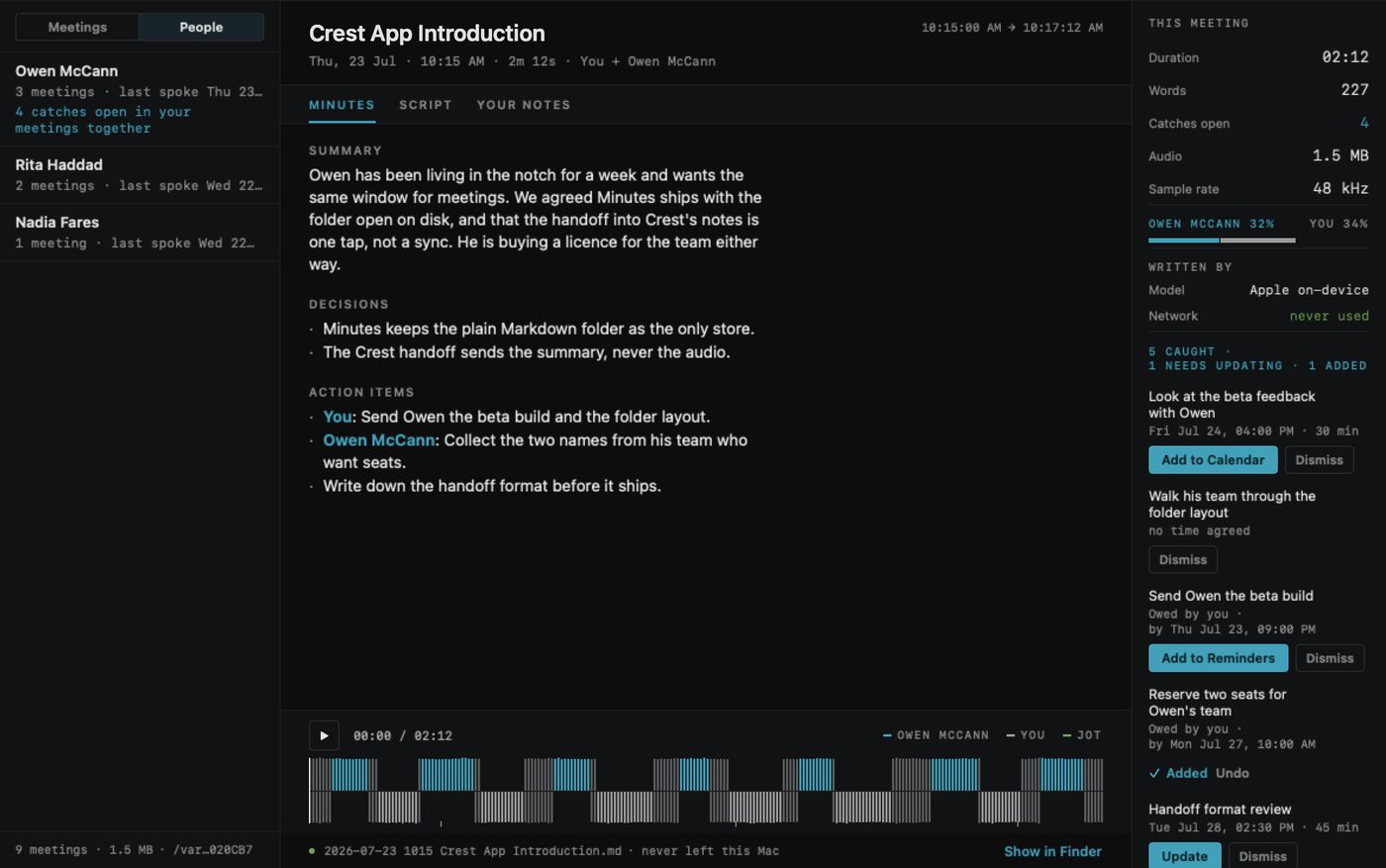
Real screenshot. A real meeting recorded on a real Mac, transcribed and summarized on device, with four things caught and added.
TRY IT
Press Add and the reminder is written. Until then nothing has been touched, and if you would rather it forgot, Dismiss means it never comes back. Every catch carries the sentence it came from, so you can check the note before you trust it.
Minutes has no backend. Audio is written to your disk, transcribed by macOS on your Mac, and summarized by a model that ships inside the operating system. Nothing is sent anywhere at any point, online or off, and there is no setting to get wrong. The only network calls the app ever makes are the one that checks your licence and the one that looks for an update.
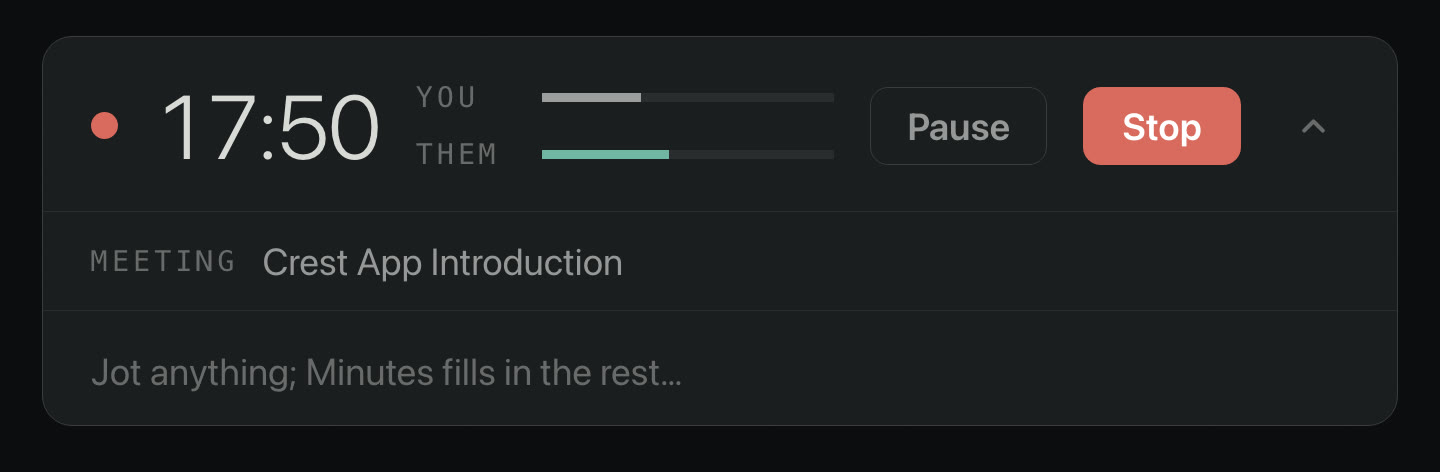
No live transcript scrolling past your face, no robot joining the meeting to announce itself. Minutes stays out of the way and does the work when the call ends.
Your microphone on one track, the audio your meeting app plays on another. Headphones change nothing, because it taps the app digitally rather than listening to a speaker. Nobody's words end up attributed to the wrong person.
One line to note the thing you must not forget, while the call keeps going. Everything else can wait until it is over.
macOS can starve other apps of the mic during some VoIP calls. Minutes tells you live at eight seconds and rebuilds its engine to win it back, and the other side records regardless.


A summary is easy to write and easy to ignore. What actually costs you is the thing somebody agreed to on minute nineteen. Minutes finds those and hands them to you as something you can act on in one tap.
Full automatic catching is a setting, and it is off until you turn it on. Review then one tap is the default, on purpose.

Real screenshot of a finished note.
No database, no export, no lock-in. Every meeting is one .md file with the summary, the decisions, the catches and the transcript inside it.
A recording takes the name of the meeting it belongs to and lists who was there, instead of leaving you to work out what Recording 47 was.
Meetings down the left in the order they happened, each with a waveform so you can see where the talking actually was.
File a summary into Crest's Notes with one tap. No sync, no second account: the two apps just talk on your Mac.
The popular meeting notetakers are cloud services: they upload your meeting to their servers, bill you every month, and keep your notes in their app. Minutes took the other road on every row.
| Feature | Minutes | Granola | Otter | Fireflies |
|---|---|---|---|---|
| On-device transcription | Yes | Cloud | Cloud | Cloud |
| Works fully offline | Yes | No | No | No |
| Audio never uploaded | Yes | Uploaded, then deleted | No | No |
| One-time purchase, no subscription | Yes | No | No | No |
| Plain Markdown you own | Yes | In their app | In their app | In their app |
| Action items into Apple Calendar and Reminders | Yes | No | No | No |
| Your meetings readable without our servers | Yes | No | No | No |
| No bot joins your meeting | Yes | Yes | Optional | Bot joins |
Published by the makers of Minutes. The marks reflect each service's own documentation and privacy policy as of July 2026. Competitor names are the property of their owners. The longer Granola comparison
One payment, two Macs, every future version. Or take all three apps and save $25.
The whole notetaker: recording, on-device transcripts, summaries and catches.
2 Macs. Free updates for the life of the app.
Minutes, plus Crest in the notch and Take for your screen. They run each other.
One account, three licences, one payment.
Pay by card or crypto. Everything you own lives at your account. What changed in the last release
No. Recording, transcription and summarization all run on your Mac using the models that ship inside macOS. There is no server to send audio to. You can disconnect from the internet during a meeting and everything still works.
It taps the audio your meeting app plays, digitally, rather than listening through a speaker. Headphones make no difference, and the other side is captured on its own channel so it is never confused with your voice.
In one folder of plain Markdown files that you own and can open in any editor. There is no database and no export step. If you stop using Minutes, every note still opens.
macOS 26 on Apple Silicon. That is not an arbitrary floor: the transcription and summarization models ship inside that version of the OS, which is exactly why there is nothing to download and nothing to upload.
Yes, 7 days with no card. Make an account, confirm your email, and the download starts.
That is your call and your local law's, and Minutes is built so it is easy to be honest: the recording indicator stays visible the whole time, and when Crest offers to record a meeting it asks first rather than starting on its own.
Seven days, no card. If the notes are not better than yours, you have lost nothing but a meeting.