Private, on-device meeting notes for Mac
Most meeting notetakers are cloud services: they upload your call to a server, keep it in their app, and bill you every month. Minutes does the opposite. It records, transcribes and summarizes entirely on your Mac, saves plain files you own, and works with the network unplugged. Nothing about your meeting leaves the machine.
Last updated: July 2026
This page is published by the makers of Minutes, part of the Crest suite. The comparisons below are kept fair: the cloud tools genuinely do things Minutes does not, and we say so.
Stated plainly, because it is the whole reason this works: Minutes requires macOS 26 on an Apple Silicon Mac. There is no Intel build and no older-macOS build. The on-device transcription and summaries depend on frameworks that ship only with macOS 26, so this is a hard floor, not a preference.
What "on-device" actually means here
On-device is a phrase that gets stretched, so here is exactly what it means for Minutes, with nothing hidden:
- Recording is local. Minutes captures both sides of the call, your microphone and the other side's system audio, straight to your disk.
- Transcription is local. Apple's SpeechAnalyzer turns the audio into text right on your Mac, as you go, with zero model downloads.
- Summaries are local. Apple's FoundationModels write the summary and read the meeting for action items, also on your Mac.
- No cloud account, no API key. Your notes are not in any account and there is no key to paste. Nothing to sync, nothing to leak. You sign in once, inside the app, only to start the trial or unlock what you bought.
- Offline after activation. You need the internet once, to activate the license. After that you can unplug the network and every part of Minutes still works, because none of it needs a server.
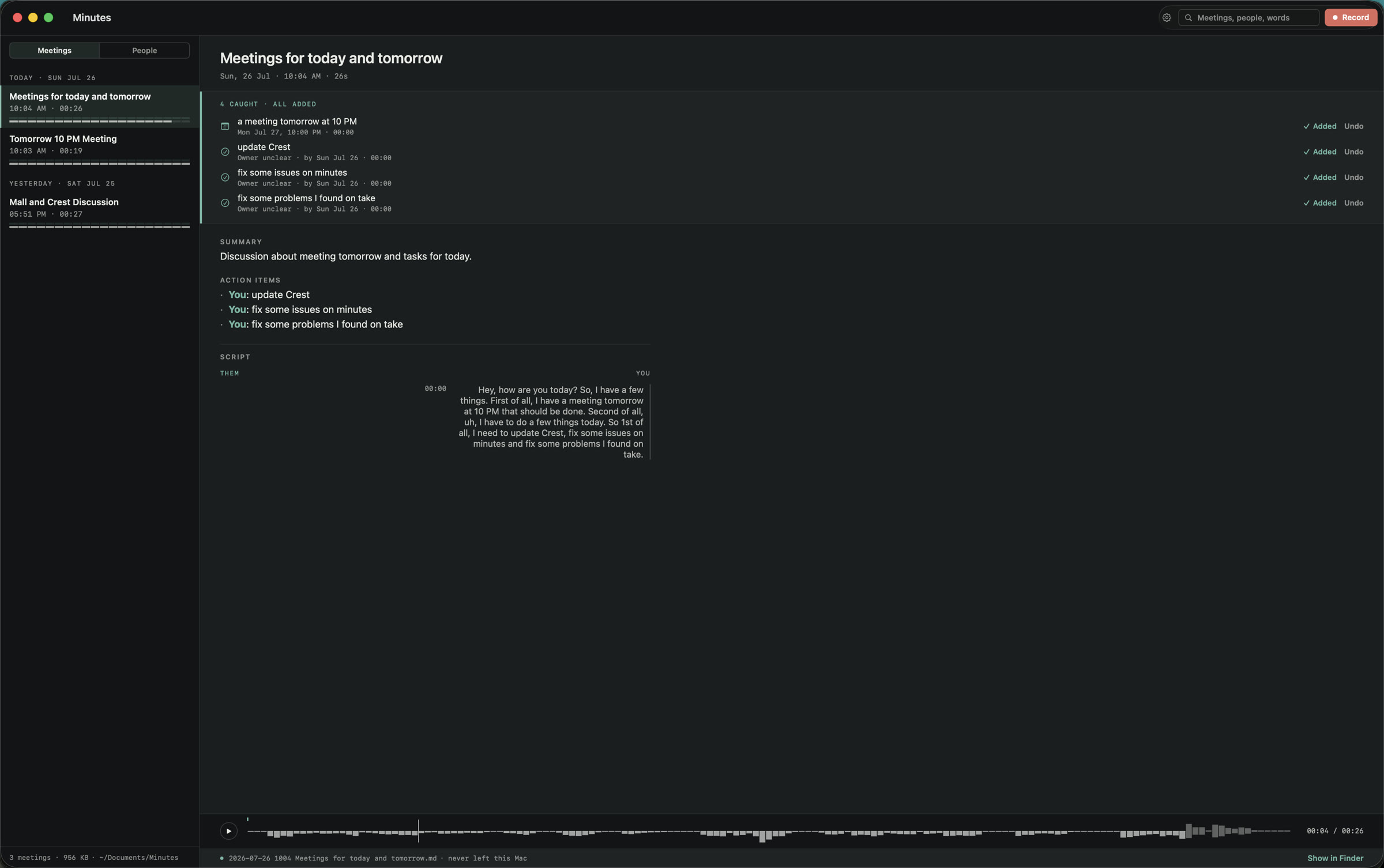
Real Minutes screenshot. A full meeting note: catches, summary, and a two-lane transcript, all on your Mac.
The cloud notetakers, and where your data goes
The popular alternatives are all cloud SaaS on a subscription, and each one needs an account. The privacy trade is the same in every case: your meeting has to reach their servers to be useful.
- Granola captures audio on your Mac, then sends the transcript and notes to its cloud to process and store them; the audio is uploaded for transcription and then deleted. It runs on a monthly subscription and requires an account.
- Otter.ai is cloud-only: every recording is uploaded to its servers, an account is required, and it runs on a subscription, around $16.99 per month for Pro.
- Fireflies.ai sends a bot to join your call, stores the recording and transcript in its cloud, requires an account, and bills per seat on a subscription.
None of that is wrong. For a team that wants shared notes reachable from any browser, the cloud is the right tool. It is simply the wrong tool for a meeting that must not leave your machine.
Side by side: Minutes vs the cloud tools
On the rows that decide privacy and ownership, this is the split:
| Feature | Minutes | Granola | Otter | Fireflies |
|---|---|---|---|---|
| On-device transcription | ||||
| Works fully offline | ||||
| Audio never uploaded | ||||
| No cloud account holds your notes | ||||
| One-time purchase, no subscription | ||||
| Plain Markdown you own | ||||
| Action items to Apple Calendar and Reminders |
A dash would undersell it, so these are marked clearly: only Minutes keeps every one of these on your machine. The cloud tools each trade one or more of these rows for reach and team features.
Files you own, not a database you rent
Privacy is not only about the network. It is also about whether you can walk away with your notes. In Minutes, every meeting is written as plain Markdown next to its audio, in a folder you choose. You can read it in any text editor, search it with any tool, point it at Obsidian, drop it into a git repo, or back it up like any other files. A People index gathers who was in which meeting. There is no proprietary database, no export step, and no lock-in. The cloud tools keep your notes inside their app, which means your history lives on someone else's server for as long as you keep paying.
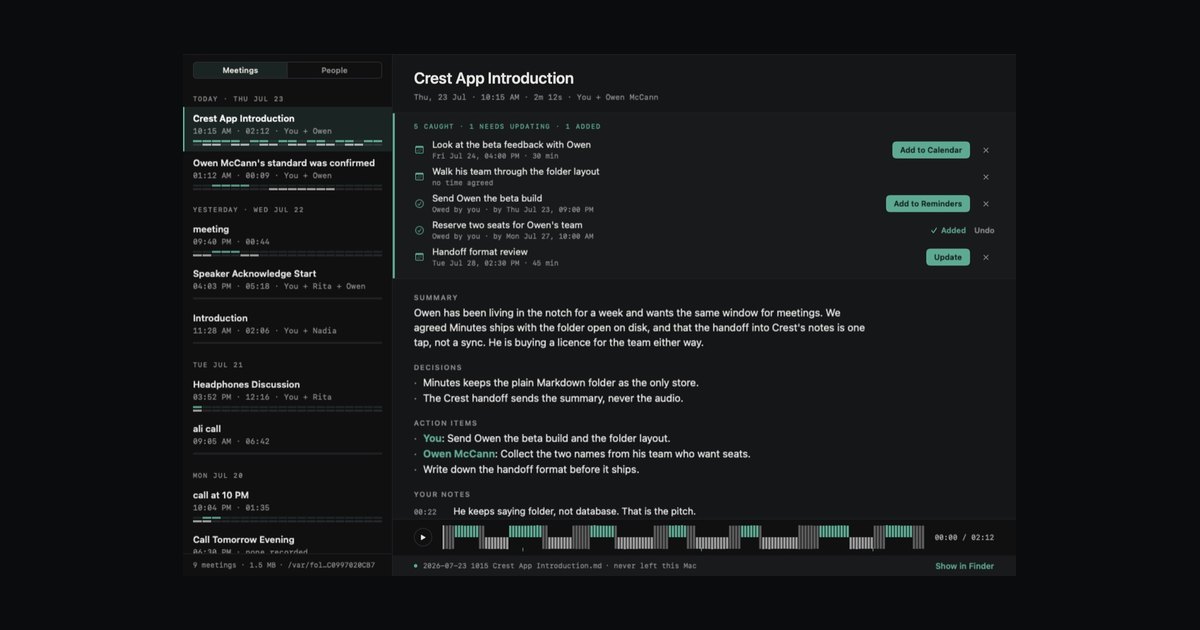
Real Minutes screenshot. Caught action items you review before they are added to Calendar or Reminders.
Where the cloud tools still win
Fair is fair. Granola, Otter and Fireflies are polished products with real strengths that Minutes does not match:
- Teams and sharing. Shared workspaces and web access mean a whole team can read the same meeting from any device. Minutes is a single-Mac tool.
- Integrations. The cloud tools plug into other software your company already uses. Minutes writes files and hands catches to Apple Calendar and Reminders, and stops there.
- Any device. Because they live in the cloud, they open on a phone or a browser anywhere. Minutes runs on your Mac and only your Mac.
If those matter more to you than keeping meetings off the network, one of the cloud tools is the honest pick. If privacy and ownership come first, that is exactly the gap Minutes fills.
The requirement, stated plainly: macOS 26 on Apple Silicon
Minutes only runs on macOS 26 on an Apple Silicon Mac. There is no Intel build and no macOS 25 build. The reason is the same reason it can be fully private: it transcribes with Apple's SpeechAnalyzer and summarizes with Apple's FoundationModels, and those frameworks ship only with macOS 26. That is also why there are zero model downloads, the intelligence is already on your Mac. If you are on an older macOS or an Intel Mac, Minutes will not run for you today, and we would rather you know that before you buy.
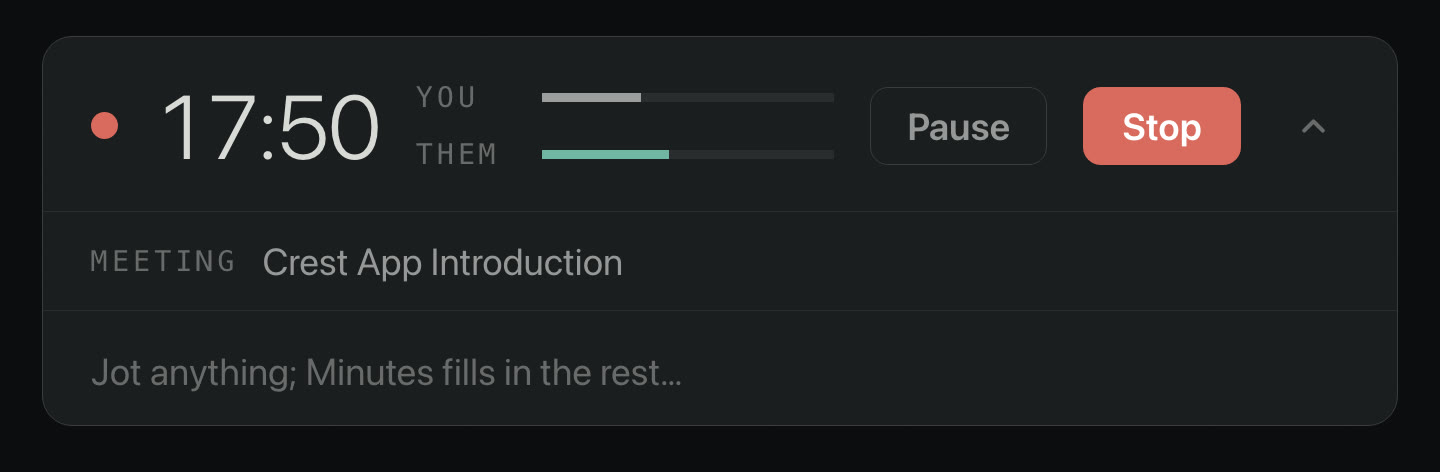
Real Minutes screenshot. Recording stays visibly indicated. Consent-forward, never covert.
Who this is for
Minutes is for the person who takes meetings that should not sit on someone else's server: legal, medical, HR, founder and investor calls, therapy and coaching, journalism, anything under an NDA. If that is you, and you are on macOS 26 with Apple Silicon, you get real notes, on-device transcription and summaries, and plain files you own, for one payment, with nothing uploaded. See how Minutes works.
FAQ
Are meeting notes in Minutes actually private?
Yes. Minutes records, transcribes and summarizes entirely on your Mac. The audio, the transcript and the summary never leave the machine, no account holds your notes and there is no API key to paste. The cloud notetakers, Granola, Otter and Fireflies, all upload your meeting to their servers to process and store it.
Does Minutes work without an internet connection?
Yes. You need the internet once, to activate your license. After that you can unplug the network and Minutes keeps recording, transcribing and summarizing, because the models run on your Mac. The cloud tools stop working the moment you go offline.
How is Minutes different from Granola, Otter and Fireflies?
Those three are cloud services: each one uploads your recording or transcript to its servers, requires an account, and bills you every month. Minutes runs on your Mac, is a one-time purchase, keeps no account of your notes, and writes plain Markdown you own. That is the whole difference: where your meeting lives.
What Macs does Minutes need?
Minutes requires macOS 26 on an Apple Silicon Mac. It transcribes with Apple's on-device SpeechAnalyzer and summarizes with Apple's on-device FoundationModels, and those frameworks ship only with macOS 26. That is also why there are zero model downloads: the intelligence is already on your Mac.
Where are my meeting notes stored?
In a plain folder you choose. Every meeting is Markdown plus its audio, in an open format you can read, search, back up, or point at Obsidian or git. There is no proprietary database, no cloud, and no lock-in.
Keep every meeting on your Mac
Minutes records both sides, transcribes and summarizes on device, and saves plain Markdown you own. No cloud, nothing to sync, works offline. One-time $15. Requires macOS 26 on Apple Silicon.
$15 one-time · 7-day trial · macOS 26, Apple Silicon
Keep reading: Best Mac meeting notes apps in 2026 · vs Granola · vs Otter.ai · vs Fathom · vs Fireflies.ai · vs tl;dv · vs Notion AI · Notes without a bot · Local AI note takers · Record a call on a Mac · Minutes overview