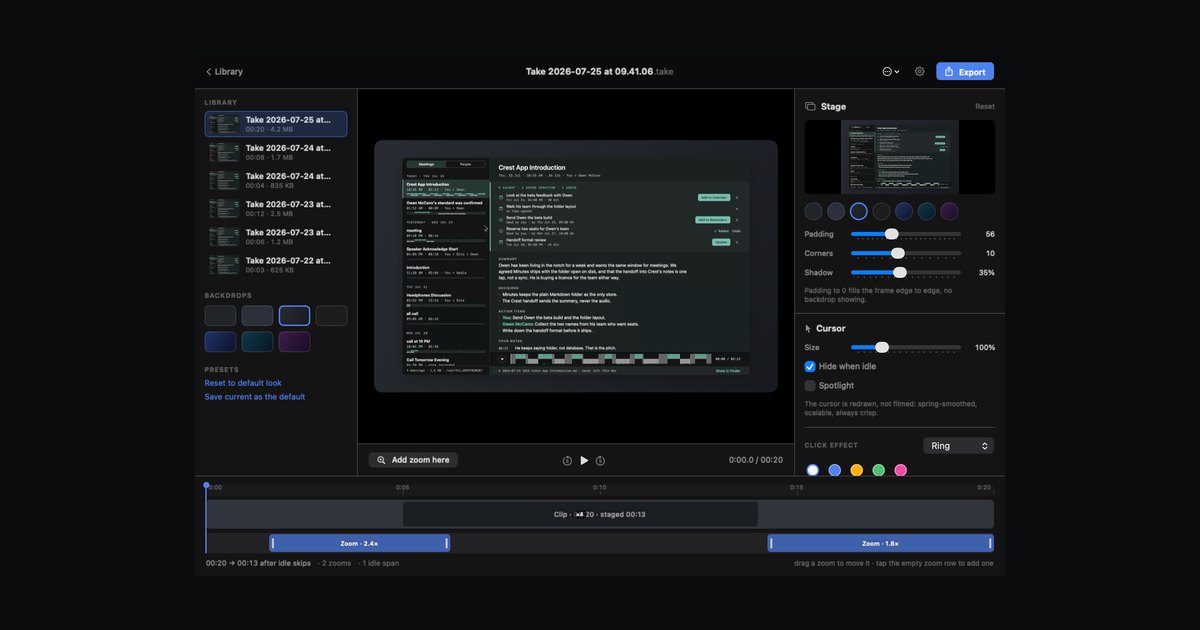
Stop the recording and it is already staged: a real backdrop, rounded corners, a cursor that glides instead of jitters, and zooms placed where you actually clicked. Then change any of it live, on a timeline, and watch the canvas follow. The Screen Studio class, native, offline, and bought once. And new in 2.1: the same staged screen can go out live, as a camera that Meet, Zoom and FaceTime can pick.
No card for the trial · no watermark, ever · macOS 14 Sonoma or later, universal · signed and notarized
75 seconds: record, edit live, then go on air with the same staged screen. Drawn from the real interface.
Real screenshot of the Take editor. Every zoom on that timeline is an object you can drag, retime or delete, and the frame on the canvas came out of the same compositor that writes the exported file.
TRY IT
Scrub the timeline, drop a zoom in, turn the face bubble on. The frame changes as you go, because the thing drawing this preview is the thing that writes the file. There is no apply step and no waiting.
Take records the screen and, separately, the truth about what happened on it: where the cursor went, when you clicked, which window moved. The staging is solved from that, which is why it can stay editable instead of being baked into pixels.
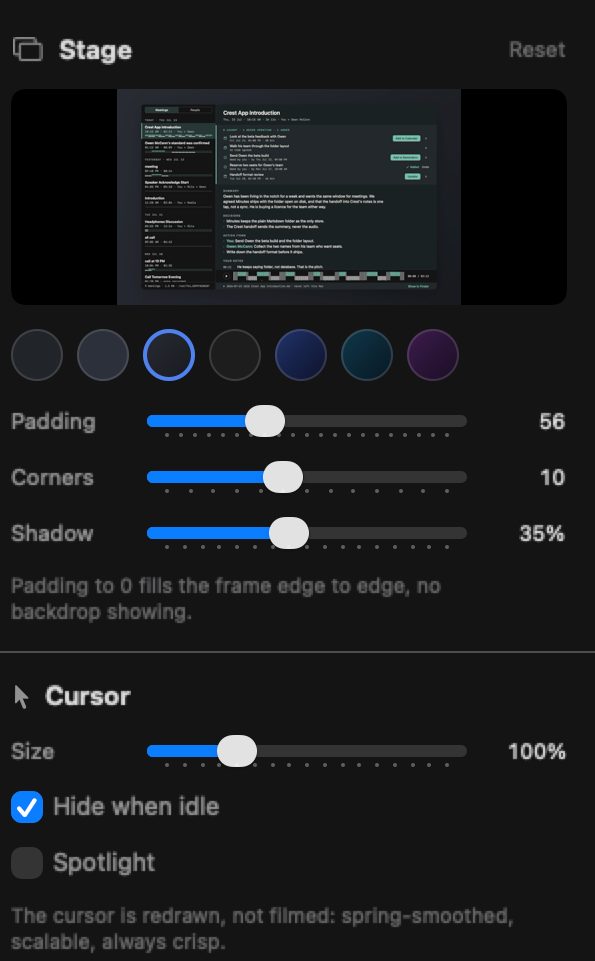
Padding, rounded corners and a true shadow, over a backdrop you pick. Set padding to zero and it fills the frame edge to edge. Save the look you like as the default and every future take arrives wearing it.
Redrawn from its own track rather than filmed, so it stays crisp at 2.4x zoom. Spring-smoothed, resizable, with hide-when-idle and a spotlight that dims everything but the pointer.
Solved from click clusters, then handed to you as clips on a timeline. Drag one to move it, tap the empty row to add one, delete the one that guessed wrong.


Most recorders make you commit: apply the edit, wait for a render, watch it back, undo, wait again. Take runs one compositor for both the live canvas and the exported file, so the thing you are scrubbing IS the thing you will ship.

Real render from the shipping compositor.
A ring where you clicked and a real motion blur on fast pans, so a viewer's eye follows the action instead of losing it.
A live circular camera you can drag anywhere or pin to a corner, recorded separately and composited at export. Off by default, because most demos do not want a face.
Record a cabled iPhone inside its actual device bezel, no mockup afterwards.
Reframe a take to vertical and the zooms are re-solved for the new shape rather than sliced down the middle.
Transcribed by macOS on your Mac and burned in if you want them. No upload, no per-minute bill.
MP4, ProRes, animated GIF and raw passthrough, each showing a real size estimate before you commit to it.
Everything Take does to a recording, it can now do to a call. Open the Live Studio, go live, and every video app on your Mac gains a camera named Take Camera. Pick it in Google Meet, Zoom, FaceTime or OBS and the call sees what the studio monitor shows: your screen on its backdrop, your face in the bubble, zooms following your clicks.
Install the camera once from the studio, approve it once in System Settings, and it is there for every app. There is a remove button right beside install, because a camera you cannot uninstall is not yours. Your self view in Meet or FaceTime appears mirrored, the way those apps show every camera; everyone else sees it the right way round.
Take is not alone on any single row. It is the only one that lands every row at once: a one-time, native, offline recorder that stages your captures and edits them live.
| Take | Screen Studio | CleanShot X | Loom | |
|---|---|---|---|---|
| One-time purchase, no subscription | Yes | No | Yes | No |
| No watermark on your recordings | Yes | Yes | Yes | Free plan brands them |
| Plain .mov files, no project format | Yes | Project based | Yes | Cloud hosted |
| Works fully offline | Yes | Yes | Yes | Cloud based |
| Native Mac app, not Electron | Yes | Yes | Yes | No |
| Automatic staging: zoom, backdrop, smoothed cursor | Yes | Yes | No | No |
| Live edits as timeline objects, preview equals export | Yes | Renders on export | No | No |
| Built-in camera bubble | Yes | Yes | Yes | Yes |
| iPhone capture with device frames | Yes | Yes | No | No |
| Live virtual camera with the staged look, for Meet and Zoom | Yes | No | No | No |
Published by the makers of Take. The marks reflect each app's own documentation and pricing as of July 2026. Competitor names are the property of their owners. The longer Screen Studio comparison
One payment, two Macs, every future version of Take. Or take all three apps and save $25.
The whole recorder: staging, live editing, every export format, no watermark.
2 Macs. Free updates for the life of the app.
Take, plus Crest in the notch and Minutes for your meetings. They run each other.
One account, three licences, one payment.
Pay by card or crypto. Everything you own lives at your account. What changed in the last release
Yes. Take runs fully for 7 days with no card. Make an account, confirm your email, and the download starts. Nothing is watermarked during the trial or after it.
Yes. You need internet once to activate. Recording, staging, editing and exporting all run on your Mac using Core Image and Metal. Nothing you record is uploaded anywhere.
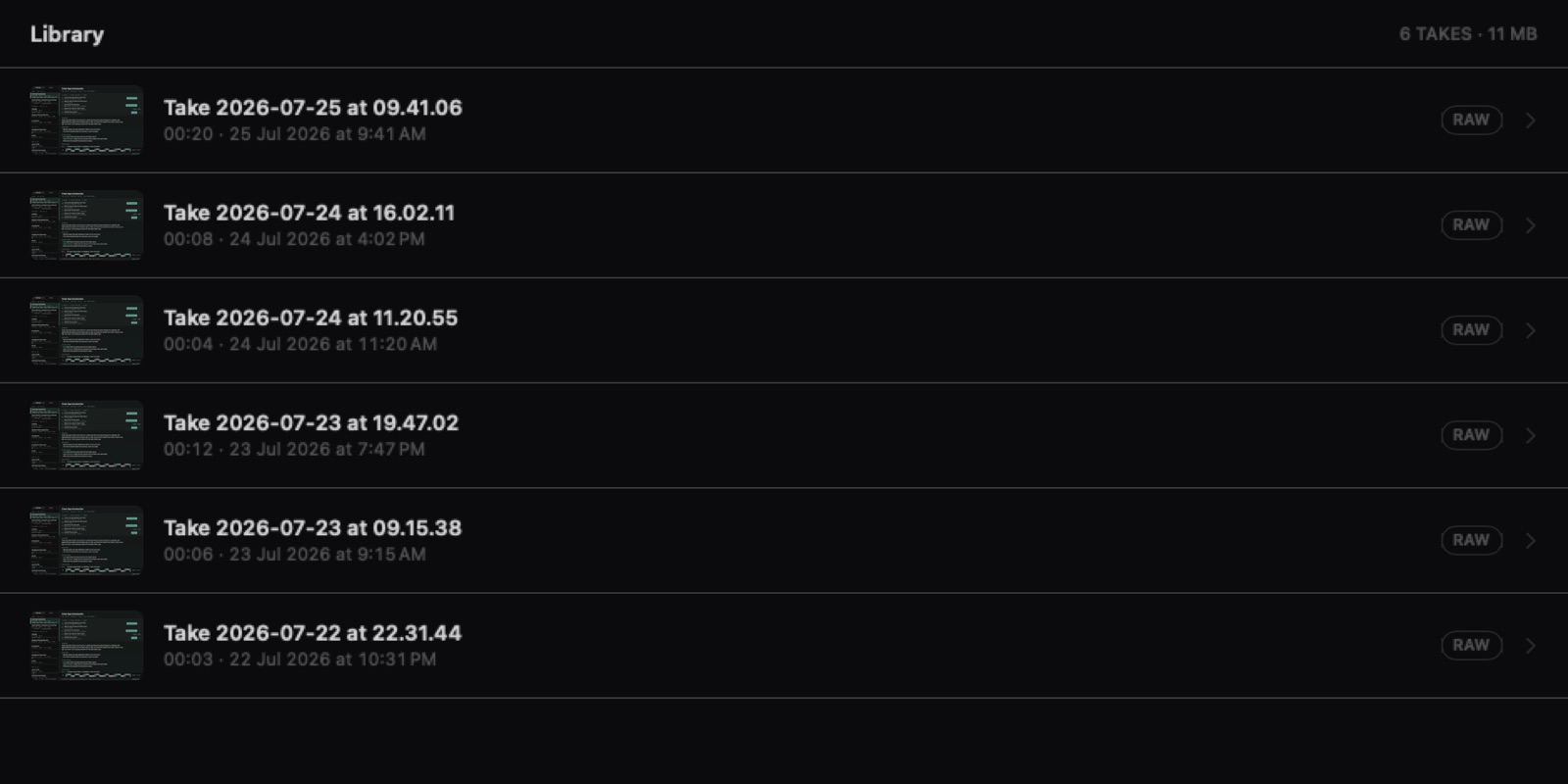
Takes are ordinary .mov files in an open folder, with a small sidecar next to each one holding the edits. There is no watermark, ever, and no proprietary project format to export out of.
Any Mac on macOS 14 Sonoma or later. The app is universal, so Apple Silicon and Intel both run natively.
Yes. Open the Live Studio, go live, and pick the camera named Take Camera in Meet, Zoom, FaceTime or OBS. The call sees your staged screen: backdrop, camera bubble, zooms and scene switches, exactly what the studio monitor shows. Install the camera once from the studio and approve it once in System Settings.
Take matches it on automatic staging and adds live editing, where moving a zoom updates the canvas immediately because the preview and the export use the same compositor. Take also presents live through a virtual camera, which Screen Studio does not do. Screen Studio is subscription-only for new buyers and project-based; Take is one payment and plain files.
Take checks for updates by itself and can install them in place, and there is a Check for updates button in Settings if you would rather ask. Every update is free.
Seven days, no card, no watermark. If it does not beat what you use now, you have lost nothing.