Take vs Screen Studio: which Mac screen recorder should you buy?
Screen Studio set the bar for cinematic screen recordings, and it is still one of the best. The catch for new buyers is the price: it is subscription-only now. Take gives you the same staged, auto-zoom look for a one-time $24.99, fully offline, with plain files you own. Here is the honest side-by-side.
Last updated: August 2026
Full disclosure: this page is published by the makers of Take, part of the Crest suite. We have kept the Screen Studio side fair and specific, including the things it genuinely does better, so this is useful whichever one you end up with.
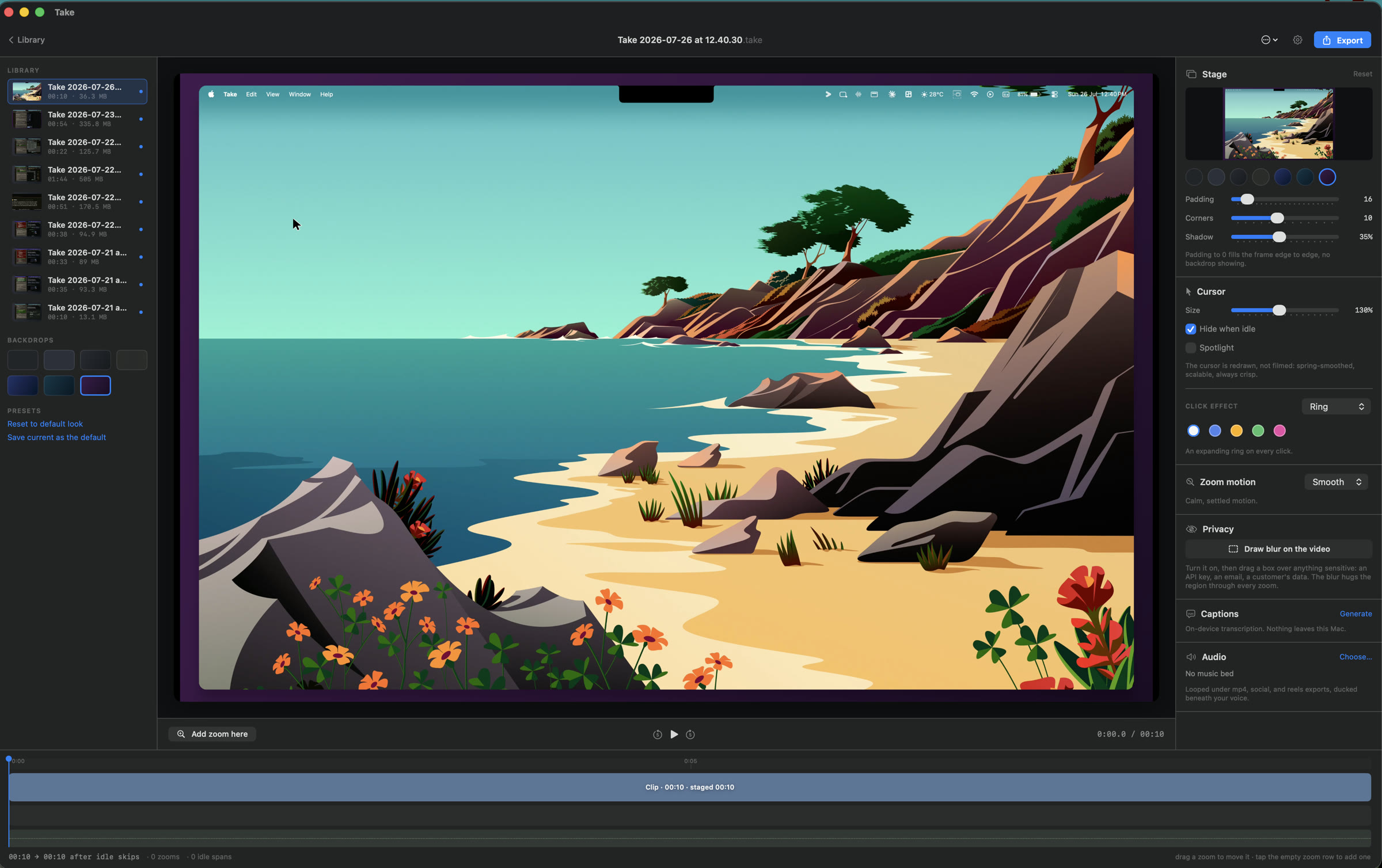
Take's edit view. Every zoom and speed-up is a deletable object, and the preview equals the export.
The short version
Pick Screen Studio if you want the most mature, refined cinematic recorder in the category and you are fine paying a subscription (from $108 a year) for it.
Pick Take if you want the same staged, auto-zoom recordings for a one-time $24.99, running fully offline, saved as plain .mov files you own, with live editing where the preview is exactly the file you export. And if you present in meetings, only one of the two can put that staged screen into Google Meet or Zoom live, through a virtual camera.
Side by side
| Take | Screen Studio | |
|---|---|---|
| Price | $24.99 one-time | from $108/year subscription |
| One-time license for new buyers | Yes, pay once | No, its one-time license was discontinued |
| Native Mac app | Yes | Yes |
| Auto zoom, smoothed cursor, backdrop staging | Yes | Yes |
| iPhone capture with device frames | Yes, real bezels | Yes |
| Camera bubble, mic and system audio | Yes | Yes |
| Live editing, preview equals export | Yes, no render step | No, project renders on export |
| Plain .mov files, no project format | Yes, a folder you own | No, project-based |
| Works offline after activation | Yes | Yes |
| No watermark | Yes | Yes |
| Presents live in Meet and Zoom (virtual camera) | Yes, with the staged look | No |
The marks reflect each app's own documentation and pricing as of August 2026. Screen Studio names and marks belong to their owners.
Where Screen Studio is better
- Maturity. Screen Studio has shipped for years, with a deep feature set, a large community and a lot of demo videos made in it. It is the reference product for this style of recording.
- Polish. Years of refinement show in the details. We are not claiming Take is more polished than Screen Studio; it is the newer app.
- Track record. If you want the safest, most proven pick and the subscription does not bother you, Screen Studio is an easy recommendation.
That is a genuinely strong case. What follows is where Take pulls ahead, and it is mostly about the deal and the workflow, not a claim that Take out-polishes a mature app.
Where Take is better
- One-time price. Take is $24.99 once. Screen Studio moved new buyers to a subscription, $29 a month billed monthly or $9 a month billed yearly, and the old one-time license is no longer sold. If you record demos even a few times a month, Take pays for itself inside the first year and keeps paying after.
- Offline and private. After a one-time activation, every capture, edit and export runs entirely on your Mac. Nothing you record is uploaded anywhere.
- Plain files you own. Every take is a .mov in a folder you choose, with no proprietary project format and no cloud library to escape from. Open it, move it, back it up like any other file.
- Live editing, no render wait. Take has no Apply button. Zooms, idle skips and the camera bubble are objects on a timeline, and one compositor draws both the live canvas and the final file, so the preview is exactly the export. Since 2.5, narration is an object too: record a voiceover over the timeline, detach your voice onto its own audio lane, and cut or redo a sentence without touching the picture or the system sound. Screen Studio renders on export.
- The same staging where it counts. Auto zoom, a smoothed cursor, backdrops, click rings, keystroke keycaps, a camera bubble, mic and system audio, iPhone capture with real bezels, and a 9:16 vertical or .gif export.
- It goes on the air. New in 2.1, Take's Live Studio presents the same staged screen live: a virtual camera named Take Camera that Google Meet, Zoom, FaceTime and OBS can pick, with scenes on hotkeys and one-click switches for the bubble and the zoom. Screen Studio records; it does not present live.
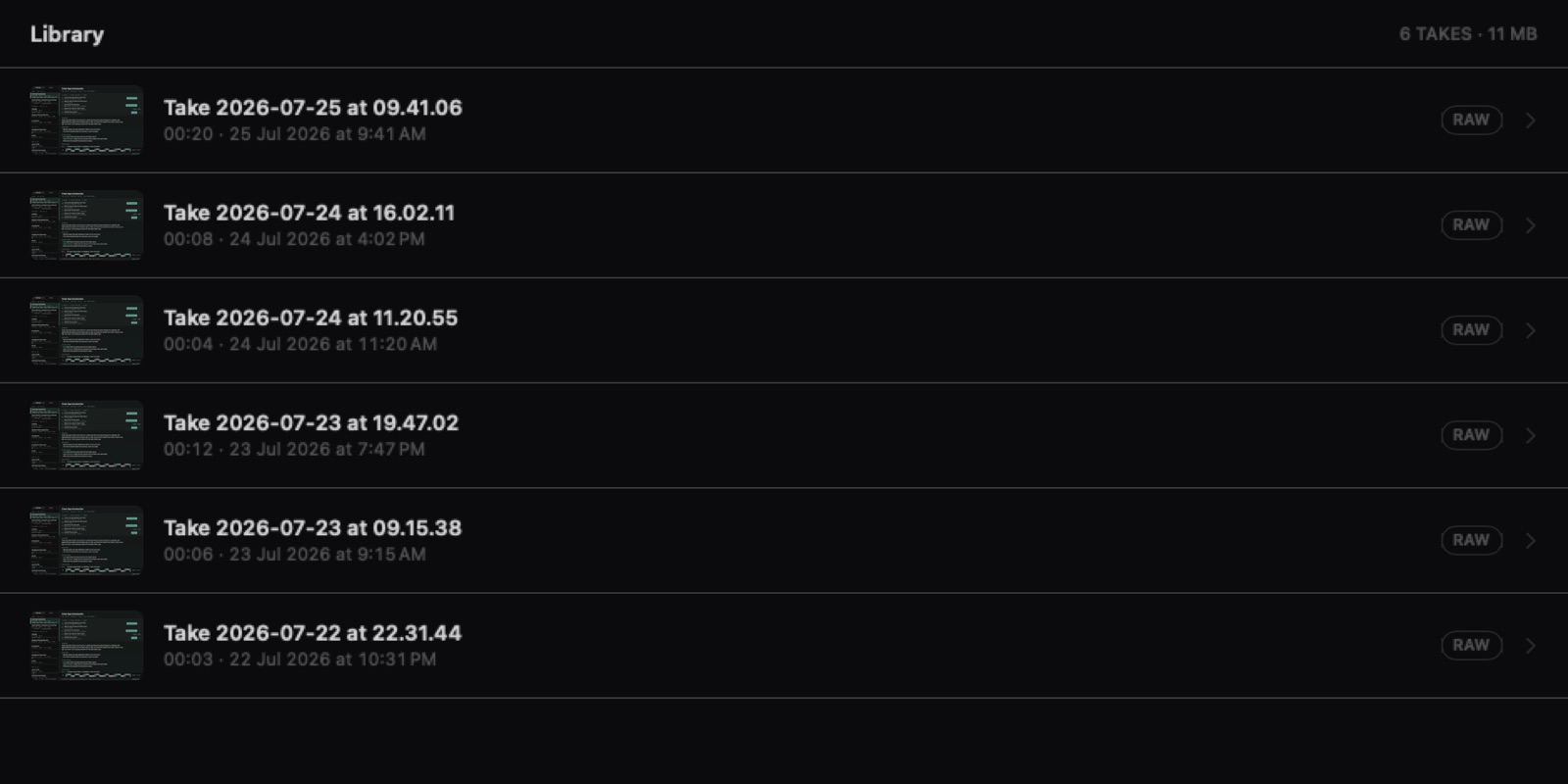
Take's library. Every recording is a plain .mov file, not a project locked in an app.
The pricing math
Screen Studio for a new buyer is a subscription: $29 a month billed monthly, or $9 a month billed yearly, from its own pricing section, checked August 2026. The one-time license it used to sell is discontinued. Take is $24.99 one-time, includes free updates, and activates on up to two Macs. Over two years that is $24.99 for Take against more than $200 in Screen Studio subscription fees. If you already pay for Screen Studio and love it, this is not a reason to switch; if you are choosing today and dislike renting your tools, the math is one-sided.
Try before you decide
This is easy to settle yourself. Take has a 7-day trial with no card up front, and the trial has no watermark, so you can record a real demo, export it, and judge the files for yourself. Record the same clip in each, then keep the one whose workflow and output you prefer. Get Take to start, or see the whole suite pricing.
FAQ
Is Take cheaper than Screen Studio?
Yes. Take is $24.99 one-time. Screen Studio is subscription-only for new buyers: $29 a month billed monthly, or $9 a month billed yearly, and its old one-time license is discontinued. Over two years Take stays $24.99 while a Screen Studio subscription runs past $200.
Is Screen Studio better than Take?
In some ways, yes. Screen Studio is more mature, with years of polish and a large user base, and it is an excellent recorder. Take's edge is the deal and the workflow: a one-time $24.99 price, full offline use, plain .mov files you own, and live editing where the preview equals the exported file.
Do Take and Screen Studio edit the same way?
Both stage automatically with auto zoom, a smoothed cursor and a backdrop. The difference is the workflow. Take edits live, so the preview on the canvas is exactly the file you export, with no separate render step. Screen Studio is project-based and renders on export.
Can Take record my iPhone like Screen Studio?
Yes. Both capture a connected iPhone or iPad and frame it in an accurate device bezel, and both can export a 9:16 vertical for Reels and Shorts.
Do I own my Take recordings?
Yes. Every take is a plain .mov file in a folder you choose, with no watermark, no proprietary project format and no cloud library. Screen Studio keeps projects in its own format with a render step before you get a shareable file.
Can either app present live in Google Meet or Zoom?
Take can. Its Live Studio adds a virtual camera named Take Camera that Meet, Zoom, FaceTime and OBS can pick, carrying the staged screen live: backdrop, camera bubble, zooms toward your clicks and scene switches on hotkeys. Screen Studio is a recorder and editor; it does not output a virtual camera.
Record once. Ship the demo.
Take stages every capture and edits it live, so the recording you export is the one you already watched. Plain files, no watermark, no subscription. $24.99 once.
Get Take for macOS, $24.99 Try free for 7 days7-day trial, no card up front. macOS 14 or later, universal (Apple Silicon and Intel).
More comparisons: Screen Studio alternatives · Best Mac screen recorders in 2026 · vs Loom · vs CleanShot X · vs Descript · vs Camtasia · vs ScreenFlow · No watermark, no time limit · Record a demo that looks edited · Take overview